
We took the processing you would find on a professional digital mixing desk — the kind that lives in a recording studio or a large-budget venue — and built it into the software. Some of it you cannot get on a normal digital desk at all without buying more equipment. All of it is here, on every channel, already switched on.
Buy for $99→
This is the chain a broadcast desk uses, and it is the chain running here — on every channel, at once, with nothing to route.
Every stage can be bypassed, and none of it has to be configured before you go live — the defaults are set for speech in a room.
A list of effect names tells you nothing. Here is the problem each one solves, and what the broadcast sounds like without it.
Turns the loud moments down so the quiet ones can come up, which makes the whole thing sound closer, warmer and more even — the sound you recognise from radio and television. Threshold, ratio, attack and release are all there if you want them, with a gain-reduction meter to watch.
Without it: a speaker who leans into the microphone and then steps back swings twenty decibels, and the viewer spends the event with a hand on the volume control.
Sets and holds the right input level on its own. It listens to what is actually arriving and corrects for a quiet speaker or a loud one without anybody touching a fader.
Without it: somebody has to notice, find the right channel and ride it — live, while the event is happening.
Catches the spikes. When somebody shouts, laughs into the microphone, or a singer suddenly belts a line, the leveller flattens that peak before it reaches the stream, then lets go again.
Without it: one shouted word clips the broadcast, and platforms that hear distortion will not thank you for it.
Closes each microphone when nobody is speaking into it and opens it the instant they do — with hold and release timed so it never clips the front of a word.
Without it: six open microphones means six copies of the room: air conditioning, chairs, traffic outside, all summed together and all louder than the person talking.
Separates the human voice from everything else and keeps only the voice. A guitar amp humming on stage, a buzzing earth loop on a faulty cable, the mains hum from a light rig, a fan, a crowd — it is identified and stripped out while the speaker carries on unaffected.
Without it: a single bad cable or a humming amp sits under the entire event and there is nothing you can do about it in the room.
Finds sibilance specifically — the harsh spit on every S — and reduces only that, leaving the rest of the voice alone.
Without it: bright microphones and close talkers hiss, and compression makes it worse rather than better.
Smooths and thickens singing voices. Two volunteers with more enthusiasm than training start sounding like a group that rehearses, with the body and blend you normally only get from a properly recorded choir.
What it is for: small teams. If you have two singers and no sound engineer, this is the single biggest difference anyone watching will hear.
Watches every open microphone and gives the gain to whoever is actually speaking, closing the rest as it goes. On a panel of six, only the person talking is fully up.
Without it: every open microphone adds room noise, and the more people on stage the worse the whole mix gets.
Listens for the resonance that becomes a howl and pulls that exact frequency down before the room hears it — not after.
Without it: the moment a speaker walks in front of a monitor is a moment your audience remembers for the wrong reason.
Drawn over the live spectrum, so you can see the frequency you are cutting while you cut it. Each band has its own filter shape and can be dragged: frequency across, gain up and down, width on the scroll wheel.
Without it: a boxy room or a boomy lectern microphone stays boxy and boomy, and you are guessing at numbers with no picture of what the sound is doing.
Three independent bands, so a chesty low end can be controlled without flattening the clarity in the upper mids.
Without it: one compressor serves the whole spectrum, and the bass ducks the vocal every time the kick drum lands.
Holds the programme inside broadcast loudness targets, so platforms do not turn you down at the other end and your event sits at the same volume as everything else in the viewer’s feed.
Without it: your stream is noticeably quieter than the video the viewer watched before it, which reads as amateur before a word is spoken.
The curve sits on top of a real-time analyser of the signal passing through it. When the room rings at 250 hertz you can see the 250 hertz, put a band on it, and watch it go — rather than sweeping blind and hoping.
Frequency, gain and width are all on the one control, per band, per channel.
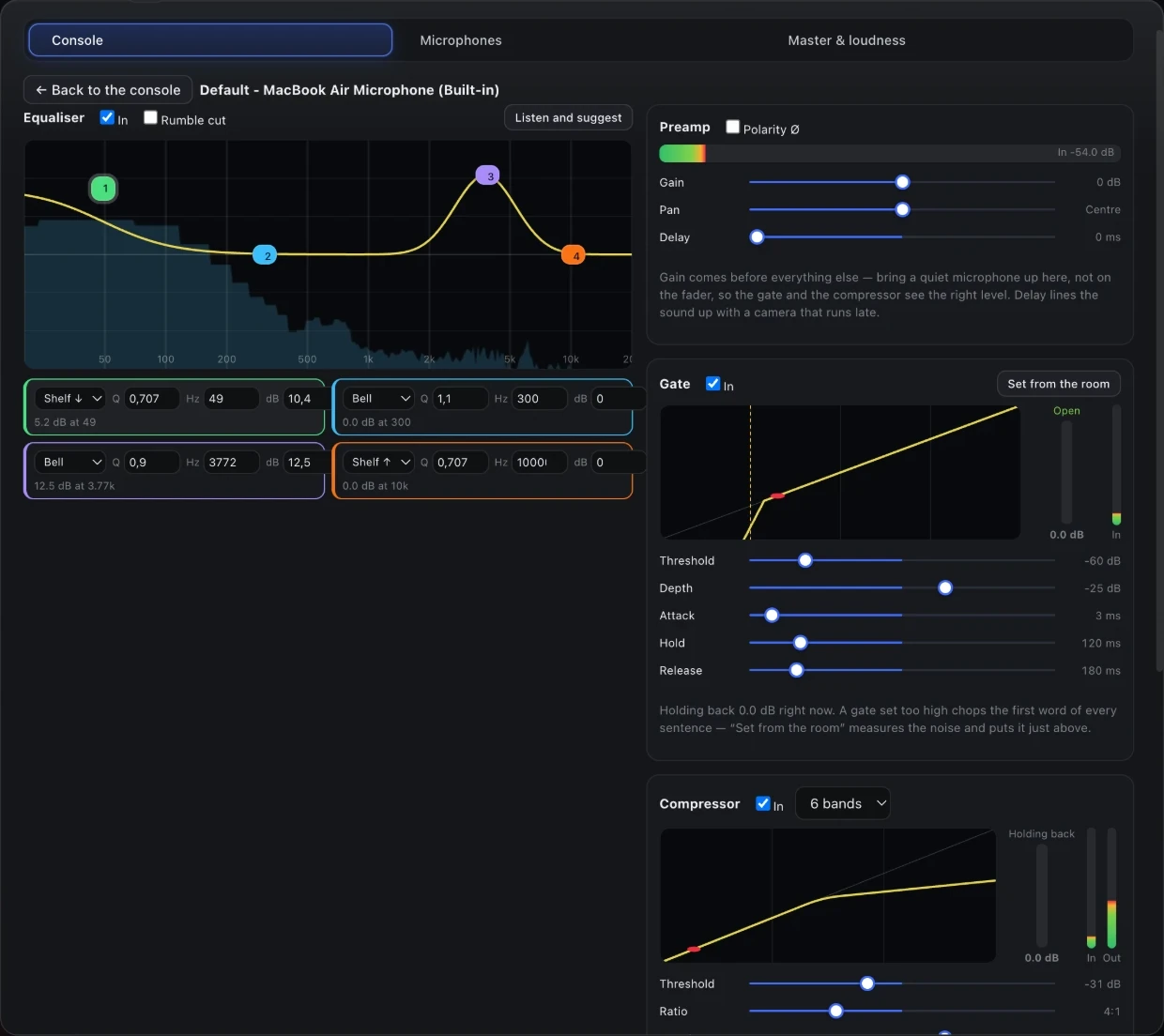
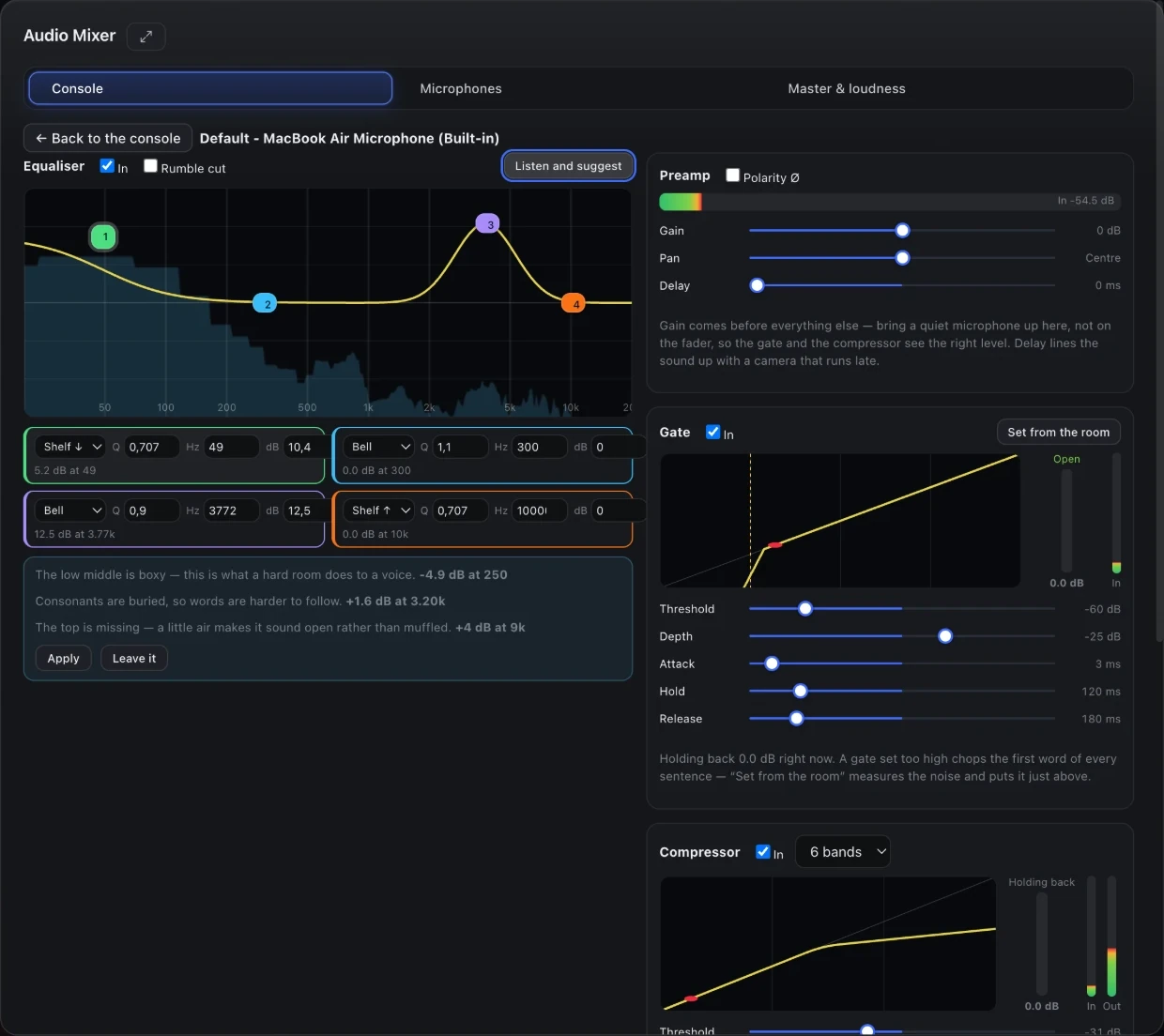
Press one button and the console listens to the microphone for a few seconds, then says in plain words what it hears — a boxy room, buried consonants, a missing top — with the change it would make for each. Apply them, or leave them.
Nothing moves on its own: you see the suggestion before it touches the sound, and the curve shows exactly what it did.
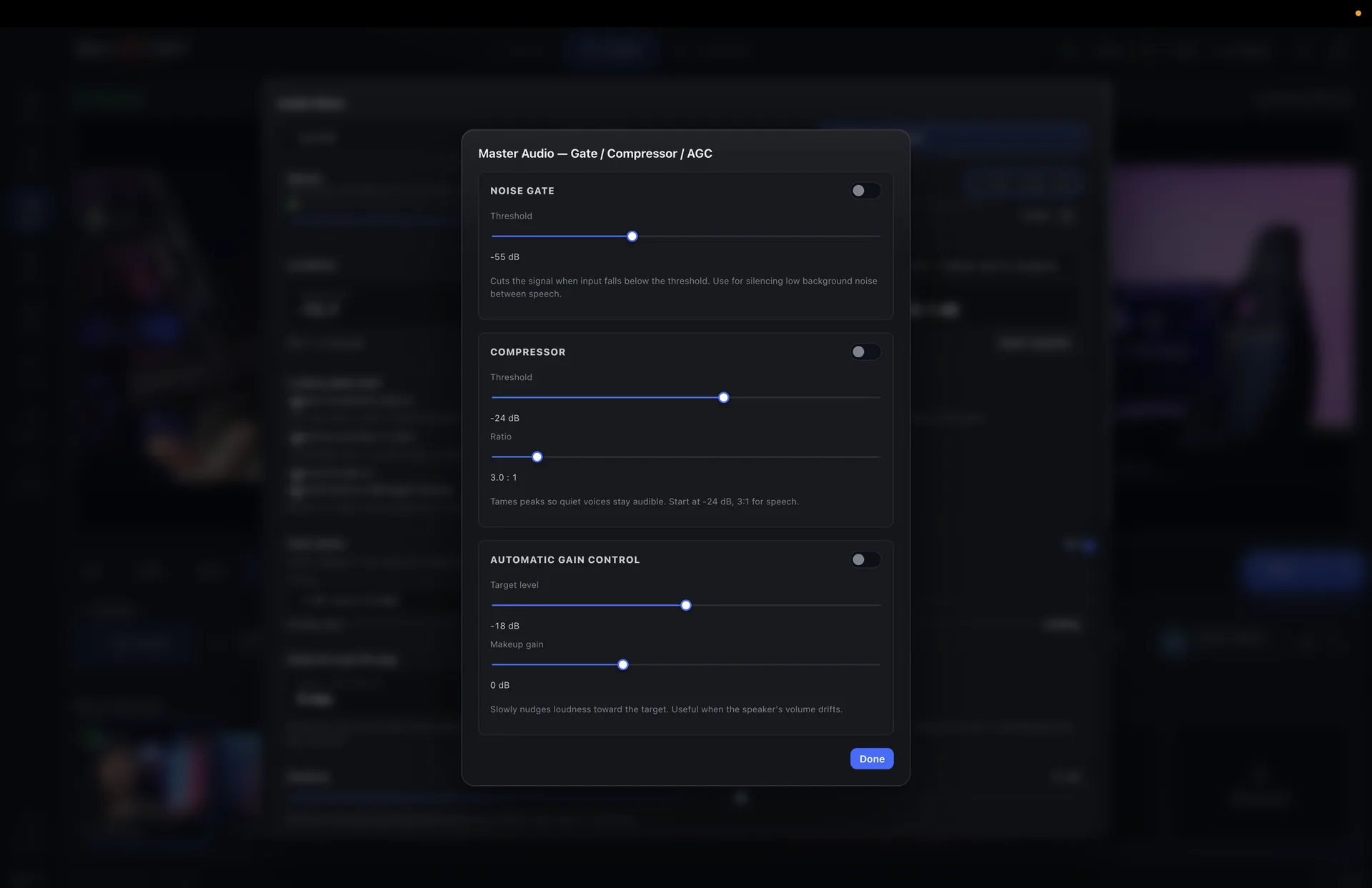
Gate, compressor and automatic levelling across the programme mix, with the loudness pilot keeping you inside broadcast targets.
There is also a silent keepalive: when nothing is playing it sends silence rather than nothing at all, because several platforms drop a stream that goes completely quiet.
Gain, phase, mute and solo on every input, with the full processing chain on each one independently.
Tune any band by hand, by number, on any channel — the same control a hardware desk gives you, without the hardware.
Assign every choir or band microphone to one group and ride the whole group on a single fader, without losing the balance you set between them.
One button takes a defined set of channels down, for the moment the room needs to be silent.
Listen to any channel in your headphones without it reaching the stream — check a microphone before you open it, live, with nobody else hearing.
A remote guest hears the whole programme except their own voice, so they are not fighting their own delayed echo.
Speak to camera operators and stage without it going to air.
Two effects buses with a send level per channel, so vocals can sit in a space without drowning speech.
Save the entire desk — every gain, every processor, every group — and recall it next week in one click.
The whole mix as a spectrum, so you can see a problem you have not yet learned to hear.
Every microphone written to its own file alongside the video, so a speaker can be repaired in the edit without the band in the way.
X32 and M32 over OSC, Allen & Heath SQ over USB, or any MIDI surface with learn.
Processing runs on every channel at once. There is no channel count at which the features start being taken away from you.
Or $19 a month. Affordable, and everything is in it — every update in the year included, nothing renews on its own. Max, with the heavy GPU features, is $599 a year or $79 a month.